Small business owner checking social media while smiling

Social media for small business owners can feel frustrating when you are posting regularly but not seeing instant sales.

You create the post.
You write the caption.
You choose the image.
You publish it.
Then you wait.

Maybe a few people like it. Maybe someone you already know leaves a comment.

Maybe nothing much happens at all.

It is easy to look at that and think, “This isn’t working.”

But often, the issue is not that social media is failing. The issue is that we are expecting it to do the wrong job.

You do not put in one post and get one sale out.

For small businesses, especially in regional NSW where reputation, relationships and word of mouth still matter deeply, the real purpose of social media is to build awareness, familiarity and trust.

Sales can absolutely come from social media. But most of the time, social media supports the sale before the enquiry happens.

It helps people notice you.
It helps them understand you.
It helps them remember you.
It helps them trust you enough to take the next step.

That is the work.

Social Media Is Not Meant to Do Everything

There is a lot of pressure on small business owners to make social media carry the whole marketing load.

Post more.
Sell more.
Get more followers.
Make better reels.
Be everywhere.
Keep up.

It is exhausting. It is also not strategic.

Social media has an important role, but it is only one part of your broader marketing system. It works best when it connects with your website, word of mouth, email list, customer service, local presence and overall brand.

If your social media is being treated as the only way people find you, trust you and buy from you, it is carrying too much weight.

A stronger approach is to give it a clearer job.

Social media should help people move from:

“I’ve never heard of you”
to
“I recognise this business”
to
“I understand what they do”
to
“I trust them enough to enquire when I need them.”
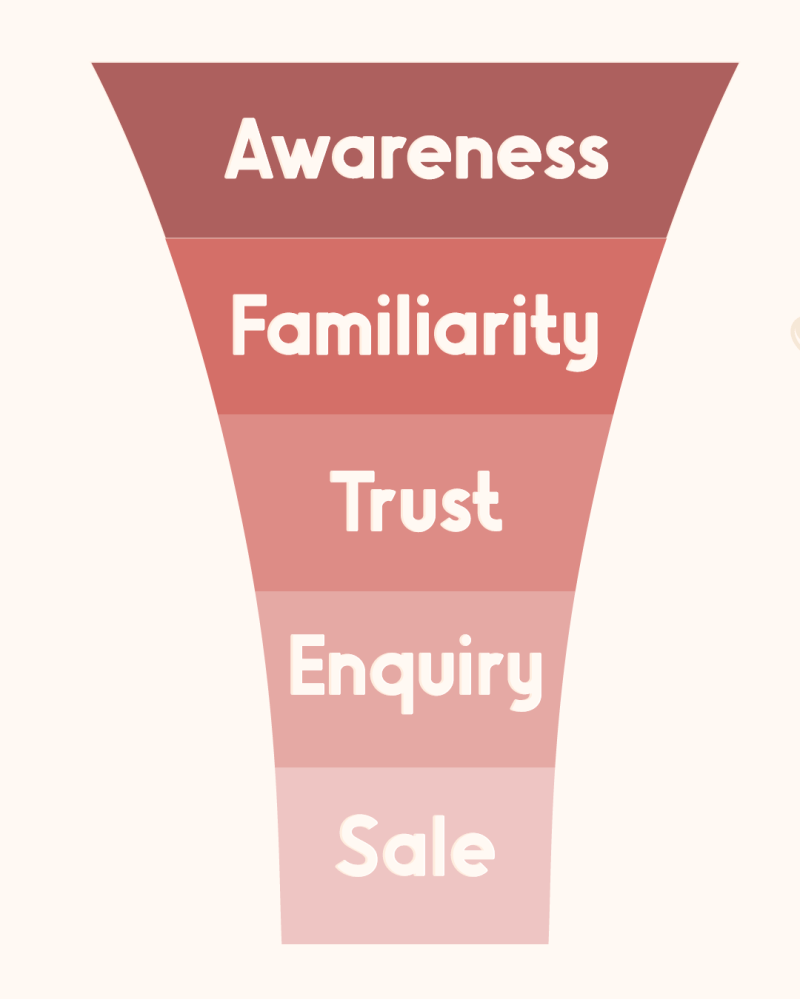
Diagram showing how social media helps small business owners build awareness, familiarity, trust and enquiries over time.

That process takes time.

And that is not a failure. That is how trust works.

The Real Job of Social Media: Awareness First

Before someone can buy from you, they need to know you exist.

That sounds obvious, but it is often overlooked.

Many small businesses jump straight to selling without first building enough awareness. They post an offer, a package, a promotion or a call to action, then feel disappointed when it does not convert.

But if your audience does not clearly know who you are, what you do, where you are based and who you help, the sales message has nowhere to land.

Awareness content helps people place your business in their mind.

It answers simple questions like:

  • What does this business do?
  • Who is it for?
  • Where is it based?
  • What problem does it help solve?
  • Why should I pay attention?

For a local café, awareness might mean reminding people where you are, when you are open and what kind of experience you offer.

For a bookkeeper, it might mean explaining who you support and what kind of business admin stress you help reduce.

For a graphic designer, it might mean showing the type of brand, print or digital design work you create.

For a health provider, it might mean helping people understand the services available before they are ready to book.

Awareness is not shallow. It is the starting point.

If people do not understand what you do, they are unlikely to trust you with their money, time or referral.

Cafe owner talking to customer.

Familiarity Builds Trust

Once people become aware of your business, the next job is familiarity.

This is where social media does quiet but important work.

People see your name more than once. They notice your tone. They recognise your colours. They start to understand your values, your process and your way of working.

Over time, your business begins to feel known.

That matters because people are more likely to enquire with a business that feels familiar, even if they have never worked with you before.

In regional communities, this is especially important. People often rely on reputation, local connection and informal trust signals. Social media can support that by showing your business consistently and honestly.

This does not mean posting every day. It does not mean sharing your whole life online.

It means showing up with enough consistency that your business does not feel invisible between sales pushes.

Familiarity can come from:

  • sharing your process
  • showing real work
  • answering common questions
  • introducing your team
  • explaining your services
  • posting customer feedback
  • showing behind-the-scenes moments
  • using a consistent visual style
  • repeating your core message clearly

You may feel like you have said the same thing too many times.

Your audience probably has not seen it that way.

Most people only see a fraction of your content. Repetition helps them remember.

Trust Comes Before Enquiry

This is where many small business owners get impatient.

They want enquiries, and that is fair. A business needs income.

But enquiry usually comes after trust.

Before someone contacts you, they may be wondering:

  • Do they seem reliable?
  • Do they understand my problem?
  • Are they active and current?
  • Do they work with businesses like mine?
  • Can I see proof of their work?
  • Will this be worth the cost?
  • Do they feel professional?
  • Do they feel approachable?

Your social media can help answer those questions before someone sends the first message.

That is why trust-building content matters.

Trust-building content includes:

  • testimonials
  • case studies
  • before and after examples
  • process explanations
  • helpful advice
  • client stories
  • frequently asked questions
  • examples of finished work
  • posts that explain your thinking

This type of content does not always get the most likes, but it often does the most valuable work.

A person may not engage publicly, but they may still be reading, watching and deciding whether your business feels right for them.

That quiet audience matters.

Not everyone who is paying attention will leave a like.

Why Every Post Does Not Need to Sell

If you expect every post to create a sale, you will end up disappointed or burnt out.

You may also start making content that feels too pushy.

There is a place for direct sales content. People need to know what you offer and how to work with you.

But not every post should ask for a booking, purchase or enquiry.

Some posts are there to:

  • remind people you exist
  • explain what you do
  • build credibility
  • answer a question
  • show your values
  • make your business easier to refer
  • help someone feel more confident
  • keep your brand visible between buying moments

That is not wasted content.

It is part of the path to trust.

A helpful way to think about this is:

Some content creates action now. Some content creates confidence for later.

Both matter.

What This Means for Regional NSW Small Businesses

Regional businesses often operate in a different trust environment to larger metro brands.

People talk. People ask around. People notice who is active, consistent and reliable. Local reputation matters.

That does not mean every post needs to mention your town or region, but your content should feel grounded in the reality of your audience.

For regional NSW businesses, social media can help you:

  • stay visible in your local area
  • strengthen word of mouth
  • show the people behind the business
  • explain services clearly before someone enquires
  • build confidence with people who have been quietly watching
  • support referrals by making your business easier to understand
  • show that your business is active, professional and approachable

The aim is not to look bigger than you are.

The aim is to look clear, consistent and trustworthy.

That is what helps people take the next step.

Give Your Next Post a Clear Job

Before creating your next social media post, pause and choose its main job.

Do not try to make it do everything.

Pick one:

Use this when people need to understand who you are, what you do or who you help.

Post idea:
“Here’s what we do and who we help.”

Best for:
New followers, local visibility, service clarity.

Use this when you want people to feel more connected to your business.

Post idea:
“Behind the scenes of how we prepare for a client project.”

Best for:
Relationship-building, local connection, showing real work.

Use this when people need proof, reassurance or confidence.

Post idea:
“A recent client came to us with [problem]. Here’s what we changed.”

Best for:
Service-based businesses, considered purchases, referral confidence.

Use this when your audience needs help understanding a problem, choice or process.

Post idea:
“Three things to check before choosing [service/product].”

Best for:
Reducing confusion, showing expertise, attracting better enquiries.

Use this when you want people to take the next step.

Post idea:
“If you need help with [specific problem], here’s how to work with us.”

Best for:
Clear offers, availability updates, bookings, contact prompts.

Quick Check Before You Publish

Ask these four questions:

  1. Does this help people understand what we do?
  2. Does this help people remember us?
  3. Does this help people trust us?
  4. Does this make the next step clearer?

Your post does not need to answer all four. But it should answer at least one.

If it doesn’t, the content probably needs a clearer purpose.

Let's Break It Down

Say you run a small allied health clinic.

A sales-only post might say:

Appointments available this week. Call now to book.

That is clear, but it only speaks to people who are ready right now.

A more strategic content mix might include:

Awareness post:
“We support children, adults and families across [region] with practical, evidence-based care.”

Familiarity post:
“A look at how we prepare our space before appointments so clients feel calm and supported.”

Trust post:
“What new clients often ask before their first appointment.”

Education post:
“Three signs it may be time to seek extra support.”

Enquiry post:
“We have limited appointments available next week. Here’s how to book.”

None of these posts are complicated, but together, they do a better job than repeating “book now” every week.

They help people understand, remember and trust the business.

That is the point.

Social Media Works Better When It Has a Purpose

Social media for small business owners does not need to be loud, constant or complicated. It just needs to be clear.

When you stop expecting every post to create an instant sale, you can start using social media more strategically.

You can:

  • Create content that builds awareness
  • Repeat your message with confidence
  • Show proof
  • Answer real questions
  • Make your business easier to understand, trust and recommend

That is how social media earns its place in your marketing.

Not as a sales machine. As a trust-building tool that helps the right people move closer to enquiry.

And when your content has that job, it becomes much easier to know what to post next.

Ready to make your social media more strategic and less stressful?

If your social media feels scattered, inconsistent or harder than it needs to be, Maya Remote Solutions can help you build a clearer plan. We help small businesses create content with purpose, so your social media supports awareness, trust and enquiries over time.