“Is it just me?”
You open your Instagram and hesitate.
Your posts feel flat. Your website looks a bit dated. A competitor pops up and everything about their brand feels sharper, clearer, more confident.
You start wondering if you need a full rebrand.
In most cases, you don’t.
What you are actually noticing is the need for a brand update. And that’s good. It means your business has grown and your standards have lifted. It means you are paying attention.
Here, we will help you work out when a brand update makes sense, what to change, and how to do it without losing time or money.
What a “brand refresh” actually means
A brand refresh (update) is not a brand restart.
It’s tweaking.
It keeps what is working and improves what no longer fits.
It’s small, strategic changes that improve clarity and consistency

A rebrand is starting from scratch.
A new direction and a new strategy.
Every aspect of your brand is rethought, reworked, and reimagined.

For most small businesses,
a brand update is the right move.
You might update:
- Colours and fonts (to feel more current or aligned)
- Imagery and graphics (to improve consistency)
- Messaging and tone of voice (to better reflect your offer)
- Website look and feel (especially your homepage)
This aligns closely with the “rebrand or refresh” conversation you may have seen across your feed recently. The takeaway is simple.
If your foundations are sound, you refine.
You do not rebuild.
7 clear signs it is time for a brand update
Your business has outgrown your brand
Your services have evolved. Your pricing has shifted. Your experience has grown.
But your brand still looks like version one.
This creates a gap between perception and reality. A brand update closes that gap.


Your marketing feels inconsistent
Your Instagram looks different to your website. Your colours shift from post to post. Your tone changes depending on how much time you had that day.
This is common with DIY marketing over time.
A brand update helps you reset your baseline and build consistency again.
Engagement has dropped off
You are still showing up, but results have slowed.
This isn’t always a content problem. Sometimes it is a clarity problem.
If people cannot quickly understand what you do or who it is for, they move on. A brand update improves that clarity.


Your competitors look more polished
You are being compared, whether you like it or not.
When another business presents more clearly, they feel easier to trust.
This doesn’t mean copying them. It means lifting your own standard so your brand supports your credibility.
You are embarrassed to share your own content
This one matters.
If you hesitate to send someone to your website or avoid posting because it “doesn’t look right”, your brand is slowing you down.
A brand update removes that friction and makes it easier to show up.

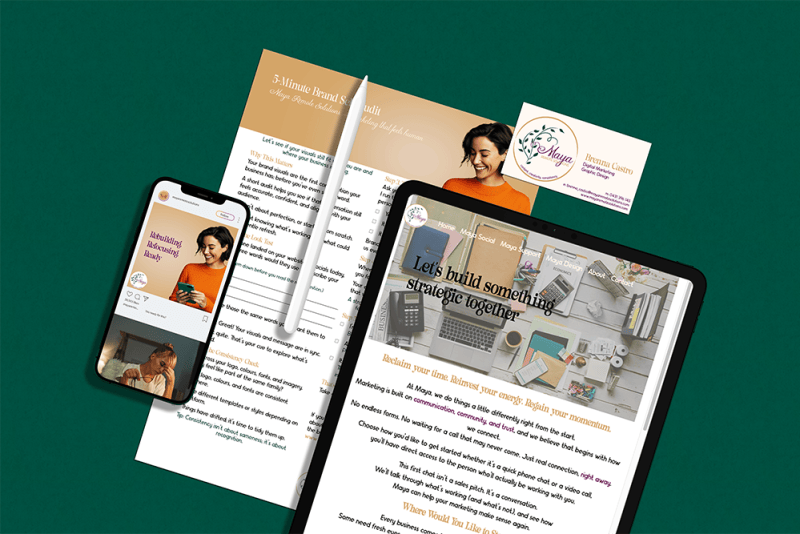
Your brand is always ‘on’ through your social media, your website and all the other customer touchpoints you use. To find out what it’s saying, read the article “What your brand is saying when you’re not looking.”

Your brand was built in a rush
Many businesses start this way. Jump online, grab a quick logo and through together your favourite colours. But no real strategy to back it up.
That is fine in the early stages. But as you grow, that lack of structure starts to show. A brand update gives your business a more stable foundation.
Your audience has changed
You have niched down. You are targeting a different type of client. You have refined your offer.
But your brand still speaks to your old audience.
A brand update brings your messaging back into alignment.

When you don’t need a brand update
Not every dip in motivation means you need to change your brand.
Hold your position if:
- Your brand is consistent and still converting
- The issue is visibility, not visuals
- You are avoiding strategy work by focusing on design
If you are not sure, revisit your strategy first. This article may help:
Why Strategy Should Always Come Before Aesthetic
What to refresh first (quick wins for busy owners)
You do not need to change everything at once.
Start where it will make the most impact.


1. Messaging clarity
Can someone understand what you do in five seconds?
If not, start here.
2. Social media templates
Create 3 to 5 templates for your posts.
This links directly to your evergreen content strategy. When your design is consistent, your content lasts longer and is easier to reuse.
3. Website homepage
Your homepage should do the heavy lifting.
Focus on:
- Clear headline
- Who it is for
- What you offer
- What to do next
You do not need a full website rebuild. A targeted brand update here can shift results quickly.
DIY vs professional help
This isn’t about right or wrong.
It’s about outcomes.
DIY works when:
- You are early stage
- You are making small adjustments
- You have time to test and refine
Invest when:
- You are raising your prices
- You are competing in a crowded space
- You want faster, more consistent results
Think of it as a time versus outcome decision.
If you are spending hours adjusting colours but are still unsure, that’s a signal that your time is better spent elsewhere.
A simple 5-step brand update process
Keep it structured.
Step 1: Audit what you have
Review your website, socials, and assets. Identify what is working and what is not.
Step 2: Define your current audience and offer
Be specific. General messaging creates weak brands.
Step 3: Update your core visuals
Refine colours, fonts, and imagery. Do not overcomplicate this.
Step 4: Align your messaging
Make sure your words match your visuals and your offer.
Step 5: Roll it out consistently
Consistency builds trust.

This connects directly to your content systems. If you want structure here, this article supports the next step: Why Ad Hoc Marketing Doesn’t Work for Small Businesses
Common mistakes to avoid
- Refreshing too often without a clear reason
- Copying competitors instead of building your own position
- Focusing only on visuals and ignoring messaging
- Trying to change everything at once
A brand update should simplify your marketing, not complicate it.
Your brand should grow with you
A brand is not a one-time task. It’s something you maintain, adjust, and improve as your business evolves.
Think of your brand like a car.
When you first start a business, you usually choose what gets you moving fastest. The practical option. The affordable option. The “good enough for now” option.
Maybe it is the equivalent of a little Toyota Yaris. Reliable. Functional. Easy to manage.
At that stage, you are focused on momentum. You just need something that gets your business on the road. So you make quick decisions about your logo, colours, website, or social media presence because the priority is starting, not perfecting. And honestly, that makes sense.
For a while, everything works well. Your business grows. The systems hold together. The brand does its job.
But over time, things begin to feel tighter. Your services expand and your audience changes. Your content grows. You need more flexibility, more clarity, more room to operate properly. Suddenly, the little car that worked perfectly in the beginning no longer fits everything comfortably.
So you adapt. You squeeze things in and you work around limitations. You spend extra time compensating for gaps.
And eventually, you start thinking: “This setup does not really reflect where the business is anymore.” That is the point where many business owners assume they need a full rebrand. But often, they do not.
The real question is this:
Are you upgrading from a Toyota Yaris to a Corolla?
Or are you wiping the slate clean and buying a Range Rover?
One is a brand update. The other is a complete rebrand.
A brand update keeps the foundations that still work, while improving capacity, consistency, and presentation. A rebrand changes the entire direction.
Most businesses do not need to throw everything away. They simply need a brand that fits the stage they are in now.
A thoughtful brand update gives you:
- Clarity in your messaging
- Confidence in your visibility
- Consistency in your marketing
That is what builds momentum over time.
If you are unsure where to start, keep it simple. Review the seven signs above and be honest about where you are.
If you want a structured next step:
- Download our quick brand checklist
- Or book a call to talk about how to identify your highest-impact changes
No pressure. Just a clear starting point.